
Thymosin Alpha-1 Dosing: The Promise, the Reality, and the Sensible Move
Here’s the pitch you’ve probably seen if you’ve gone looking for thymosin alpha-1 dosing advice: a tidy number, a frequency, maybe a “loading phase” followed by “maintenance.” It reads like settled science. It isn’t. Some of those numbers come from real randomized trials. Others come from a forum thread. They get printed with the exact same confidence, and that’s the part that bugs me.
So let’s do this differently. Instead of handing you a chart and wishing you luck, I want to walk through the promise you’ll hear, what the actual research says, and what a sensible person does with that gap. Every number below traces back to a real study you can click through and read yourself, because that’s the whole point of separating “evidence-backed” from “sounds official.”
The promise: a clean number for every use case
Scroll through enough vendor pages and forums and you’ll find thymosin alpha-1 doses attached to almost anything: hepatitis B, sepsis recovery, and, most commonly, plain old “immune support.” The numbers are specific. 1.6 mg. Twice weekly. A defined loading dose, then a maintenance dose. It all looks measured and careful, which is exactly why people trust it.
The reality: evidence lives on a spectrum, and most wellness dosing sits at the bottom of it
Here’s the thing nobody selling you a protocol wants to slow down and say out loud: a dose is only as trustworthy as the question it was actually tested against. Thymosin alpha-1 is the active ingredient in thymalfasin, a drug approved abroad mainly for chronic viral hepatitis and used as an immune adjuvant in certain cancers (World Journal of Virology, 2020) [5]. Every dose that has real trial evidence behind it was set to treat one of those specific, diagnosed conditions. Nobody ever ran a trial to find the “right” dose for a healthy person who just wants to feel more resilient, because that was never what this molecule was built or tested for.
I find it useful to think of the evidence as graded, not binary:
| Dosing parameter | Common figure you’ll see | What’s actually behind it | Grade |
|---|---|---|---|
| Per-dose amount, hepatitis B | 1.6 mg subcutaneous, twice weekly | Used in randomized controlled trials for chronic hepatitis B | A |
| Per-dose amount, sepsis | Higher, more frequent in-hospital dosing | Studied in RCTs, but the definitive 2025 trial found no mortality benefit | C |
| Treatment duration | Fixed multi-week course | Hepatitis B benefit came from a defined course, not indefinite use | A for the principle, B for length elsewhere |
| “Immune support” wellness dosing | 1 to 2 mg, a few times weekly | No controlled trials define a dose for general wellness use | D |
| Loading-then-maintenance schedules | Common in vendor protocols | Not established in controlled literature for general use | D |
Notice the shape of that table. The A-grade stuff is narrow and boring: one condition, one trial-tested regimen. Everything with broader, more exciting-sounding claims drops straight to D. That’s not a coincidence. That’s what happens when a number gets borrowed from the context it was actually studied in and repurposed for a context it wasn’t.
The one that actually earns its confidence: hepatitis B
This is where I can hand you real numbers with a clear conscience. A 1998 randomized controlled trial in Hepatology followed 98 patients through a defined 26-week course and found a complete virological response in 40.6% of patients, versus 9.4% in untreated controls, a difference that hit statistical significance (P = .004) (Hepatology, 1998) [1]. A 2008 meta-analysis in Antiviral Research pooled four trials and 199 patients and found the benefit kept building even after the course ended (Antiviral Research, 2008) [2]. That’s dosing evidence doing what dosing evidence is supposed to do: a specific regimen tied to a specific, measured outcome, in a controlled setting.
The one that was tested fairly and just didn’t pan out: sepsis
This is my favorite cautionary tale in the whole file, because it proves that “well studied” and “works” are two different sentences. The 2013 ETASS trial in Critical Care looked promising on the surface: 361 patients with severe sepsis, 28-day mortality of 26.0% on treatment versus 35.0% on control, relative risk 0.74. But the 95% confidence interval ran from 0.54 to 1.02, meaning it didn’t clear the bar for statistical significance (Critical Care, 2013) [3].
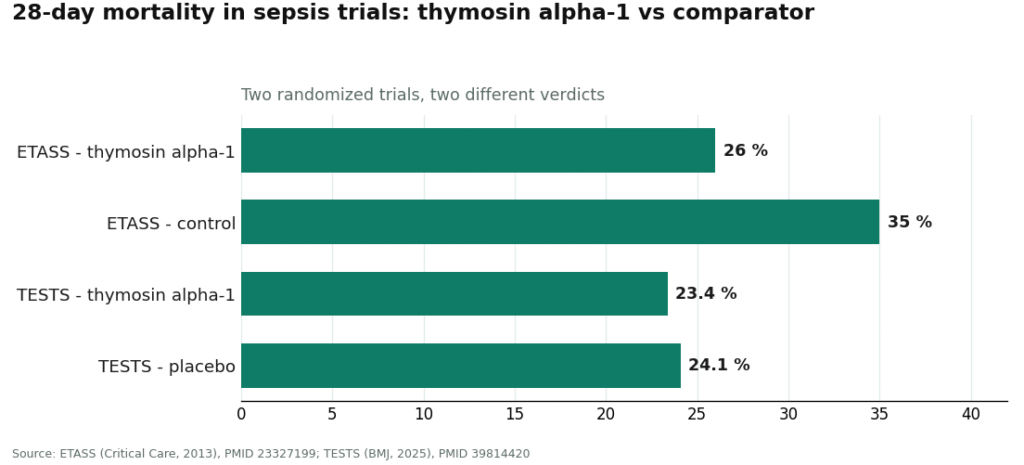
Then came the real test. The 2025 TESTS trial in the BMJ, a proper phase 3, double-blind, placebo-controlled study across 1,089 adults with sepsis, found 28-day mortality of 23.4% with thymosin alpha-1 versus 24.1% with placebo. Hazard ratio: 0.99. Translation: no meaningful difference (BMJ, 2025) [4]. So here’s the paradox worth sitting with: this regimen has more rigorous trial data behind it than almost anything on that scorecard, and the answer that data gave us was “it doesn’t move the needle.” A well-characterized dose can still be a dose that doesn’t do the job.
The one with basically nothing behind it: general “immune support”
This is probably the reason you clicked in the first place, and I’d rather tell you the honest version than a comforting one. The wellness dosing floating around online, something like 1 to 2 mg a few times a week, sometimes dressed up with a loading phase, has no controlled trial behind it at all. Nobody has run a study asking “what’s the right thymosin alpha-1 dose for a healthy adult who wants better immune function?” So when you see that dose printed with total confidence, what you’re actually looking at is a number lifted from hepatitis B trials and relabeled for a use it was never tested against. It’s not necessarily reckless (the safety data below is genuinely reassuring), but the specificity is doing more work than the evidence supports. A precise-sounding protocol isn’t the same thing as a proven one.
The delivery method matters more than people admit
One detail quietly undercuts a lot of the wellness marketing: in every trial that produced real evidence, thymosin alpha-1 was given by subcutaneous injection. That’s how an immune-signaling peptide like this gets studied. So if you see it marketed as a nasal spray or an oral capsule with “equivalent” effects, that claim isn’t coming from the same evidence base. The dose number only means what it appears to mean when it’s paired with the route it was actually tested in.
The sensible move
If you’re weighing whether to look into this at all, here’s where I land after reading through the actual trials rather than the marketing copy.
First, separate the categories in your own head the way the scorecard does. A hepatitis B regimen with a 1998 RCT and a 2008 meta-analysis behind it is not the same tier of information as a wellness dose nobody has ever tested. Treat them differently, because the evidence does.
Second, if you or a clinician are actually tracking a regimen, write it down. Not in a “someday I’ll remember” way, in an actual log: date, dose, injection site, anything you noticed afterward. Something like the FormBlends tracker app exists for exactly this (it’s a logging tool, not a prescription, not a checkout). The reason I mention it in a piece about dosing evidence is simple: a dose nobody records is a dose nobody can evaluate later. A record is what turns “I’ve been taking this for a while” into something a clinician can actually look at and adjust.
Third, respect the safety picture without over-trusting it. Across decades of use as an approved drug, thymosin alpha-1 has a generally reassuring tolerability record, mostly mild injection-site irritation, occasionally fever, fatigue, or muscle aches (World Journal of Virology, 2020) [5]. That’s good news, but it’s not the same as proof that any given wellness dose does something useful, and it doesn’t cancel out the one real red flag: because this peptide activates the immune system, it’s generally avoided in people on immunosuppressants, including organ-transplant patients. No dosing chart resolves that. A conversation with someone qualified does.
Which brings me to the actual conclusion, and it’s a little anticlimactic: the most defensible “dose” isn’t a number you copy off a page. It’s a process, where a prescribing clinician matches a regimen to a diagnosed condition, your specific situation, and what the evidence supports, the same way the researchers behind that 40.6% hepatitis B result did. A supervised path, where a qualified person is setting and adjusting the dose rather than you copying a figure from a forum, is the structural fix for everything this article just walked through. That’s the whole reason I’d rather point you toward that kind of oversight than toward one more “here’s exactly what to take” list.
Questions I’d want answered myself
What’s the thymosin alpha-1 dose with the strongest evidence behind it? The chronic hepatitis B regimen, 1.6 mg subcutaneously, twice weekly, over a defined multi-week course. It earned its grade in randomized controlled trials, where a 26-week course produced a complete virological response in 40.6% of patients versus 9.4% of controls [1]. That confidence is specific to hepatitis B. It doesn’t transfer to general wellness use.
Is there a proven dose for general immune support? No, and I mean that plainly. No randomized trial has ever set out to find a thymosin alpha-1 dose for healthy adults chasing general immunity. The 1 to 2 mg protocols you’ll see online are extrapolated from other indications, not measured against this one. A precise-looking wellness protocol is not the same thing as an evidence-backed one.
Does thymosin alpha-1 actually help with sepsis? The best current evidence says no, at least not for mortality. The 2025 TESTS trial, a proper phase 3, double-blind, placebo-controlled study of 1,089 adults, found 28-day mortality of 23.4% with treatment versus 24.1% with placebo, hazard ratio 0.99, no clear benefit [4]. This is the clearest example in the whole file of a regimen being thoroughly studied and simply not working.
Why does the same milligram number stop being trustworthy when the goal changes? Because a dose is only as good as the question it was tested against. The 1.6 mg twice-weekly figure earned its evidence in hepatitis B trials. Move that same number over to a healthy adult looking for general resilience, and the number stays put, but the evidence behind it doesn’t come along for the ride.
Could I just take it orally or as a nasal spray instead of injecting it? The trials that produced real evidence used subcutaneous injection. Any product claiming an equivalent effect through a different route is making a claim the research doesn’t back up. Change the delivery method, and the dose number stops representing what the studies actually measured.
Who should be setting the dose, realistically? A prescribing clinician, not a label on a vial. The doses with genuine evidence behind them were set inside trials for specific diagnosed conditions, and applying any of that to an individual means matching dose to person, goal, and clinical context, which is exactly what a clinician does and a vendor page can’t. It also matters because thymosin alpha-1 is generally avoided in people on immunosuppressants, such as organ-transplant patients, and that call belongs to an actual evaluation.
What is thymosin alpha-1 and what does it actually do in the body?
It’s a 28-amino-acid peptide that occurs naturally in the thymus gland, where it helps regulate immune cell activity, particularly the maturation and function of T-cells. Researchers have studied it for decades around chronic infections, certain cancers, and vaccine response. Picture it less as a volume knob and more as a signal that nudges the immune system toward a more organized response.
Is thymosin alpha-1 legal to get and use?
Depends where you are and how you’re getting it. In the US, it’s not FDA-approved as a finished drug, but a compounding pharmacy working under a physician’s prescription can legally prepare it for an individual patient. Buying it through research-chemical or peptide-supplement sites sits in a much murkier, riskier zone, with far less certainty about what’s actually in the vial. Outside the US, several countries have approved it outright, so the rules genuinely vary.
What side effects come up most often?
In clinical trials, most people reported very little. Mild redness or soreness at the injection site is the most common complaint, and systemic reactions look rare in the published data, though that data mostly reflects supervised, pharmaceutical-grade product. Since the entire point of this peptide is immune modulation, anyone with an autoimmune condition should have a real conversation with a physician before considering it.
How do I know what I’m actually buying is what it claims to be?
This is the crux of it. Peptides sold through unregulated vendors rarely come with batch-specific certificates of analysis from accredited labs, and even when they do, verifying them independently is hard. The more accountable path is a physician-supervised compounding pharmacy, like FormBlends, where dispensing is tied to an actual prescription, oversight, and documented quality controls. Skip that chain, and purity and concentration are genuinely a guess.
References
- Chien RN, et al. Efficacy of thymosin alpha1 in patients with chronic hepatitis B: a randomized, controlled trial. Hepatology. 1998;27(5):1383-1387. PMID: 9581695.
- Yang YF, et al. Comparison of the efficacy of thymosin alpha-1 and interferon alpha in the treatment of chronic hepatitis B: a meta-analysis. Antiviral Research. 2008;77(2):136-141. PMID: 18078676.
- Wu J, et al. The efficacy of thymosin alpha 1 for severe sepsis (ETASS): a multicenter, single-blind, randomized and controlled trial. Critical Care. 2013;17(1):R8. PMID: 23327199.
- Wu J, et al. The efficacy and safety of thymosin alpha 1 for sepsis (TESTS): multicentre, double blinded, randomised, placebo controlled, phase 3 trial. BMJ. 2025;388:e082583. PMID: 39814420.
- Costantini C, et al. Thymosin alpha1, a peptide ahead of its time. World Journal of Virology. 2020;9(1):1-7. PMCID: PMC7747025.
Written by Priya Mensah, research writer. Cross-checking the claims against the primary sources. Last reviewed January 2026.
Not medical advice, just context. A healthcare provider who knows your history should advise you.